


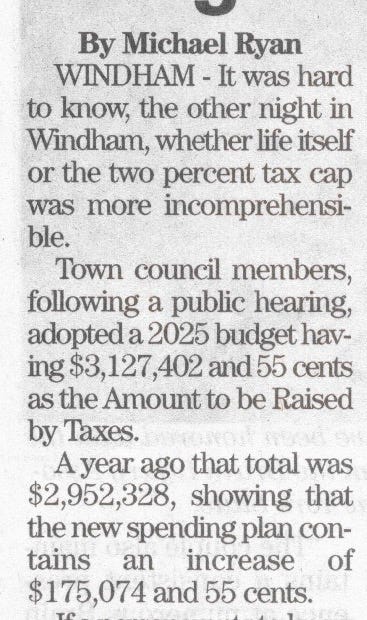
The article in the Windham Weekly ( November 15th edition) titled “Windham Navigates the Budgetary Tax Cap Waters” unfortunately will leave the average reader stuck in an alternative fact reality. We believe this is due to the fact Mr. Ryan has fallen victim to our tax system’s very complex nature when he declared that our tax burden has only risen 2.3% or $70,309.55 over the real property tax levy limit. In fact, the tax burden has risen 5.93% or $175,074.55 from last year’s tax levy of $2,952,328 to the current amount of $3,127,402.55. It’s an honest mistake we believe on Ryan’s part. However, the fact remains that 2.3% above our tax cap limit doesn’t represent the full increase in our taxes.
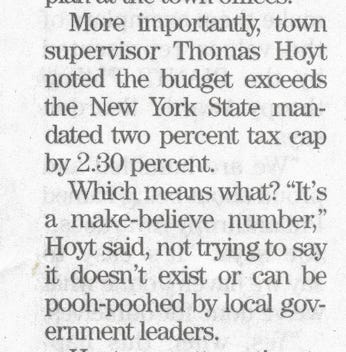
The above quote from Mr. Ryan about Mr. Hoyt calling the Tax Cap “a make-believe number” is not helpful to our community and its overall understanding of the limitations that the tax cap are designed to impose on local spending. The fact that the current Tax level is 2.30 percent more than the state limit doesn’t affect the fact that the overall tax burden is now $175, 074.55 more than it was last year. And telling the community that somehow this amount, the 2.3% change or $70, 309.55 is the entirety of the tax burden is not exactly correct either. Yes, it is very possible that our budget could have jumped $104,756 dollars without an increase in our tax cap,but the facts are simply that the funds required to pay for our governmental services amounted to $175, 074.55 plus last years $2,952,238.00. This increase resulted in a new tax levy above the Tax Cap.
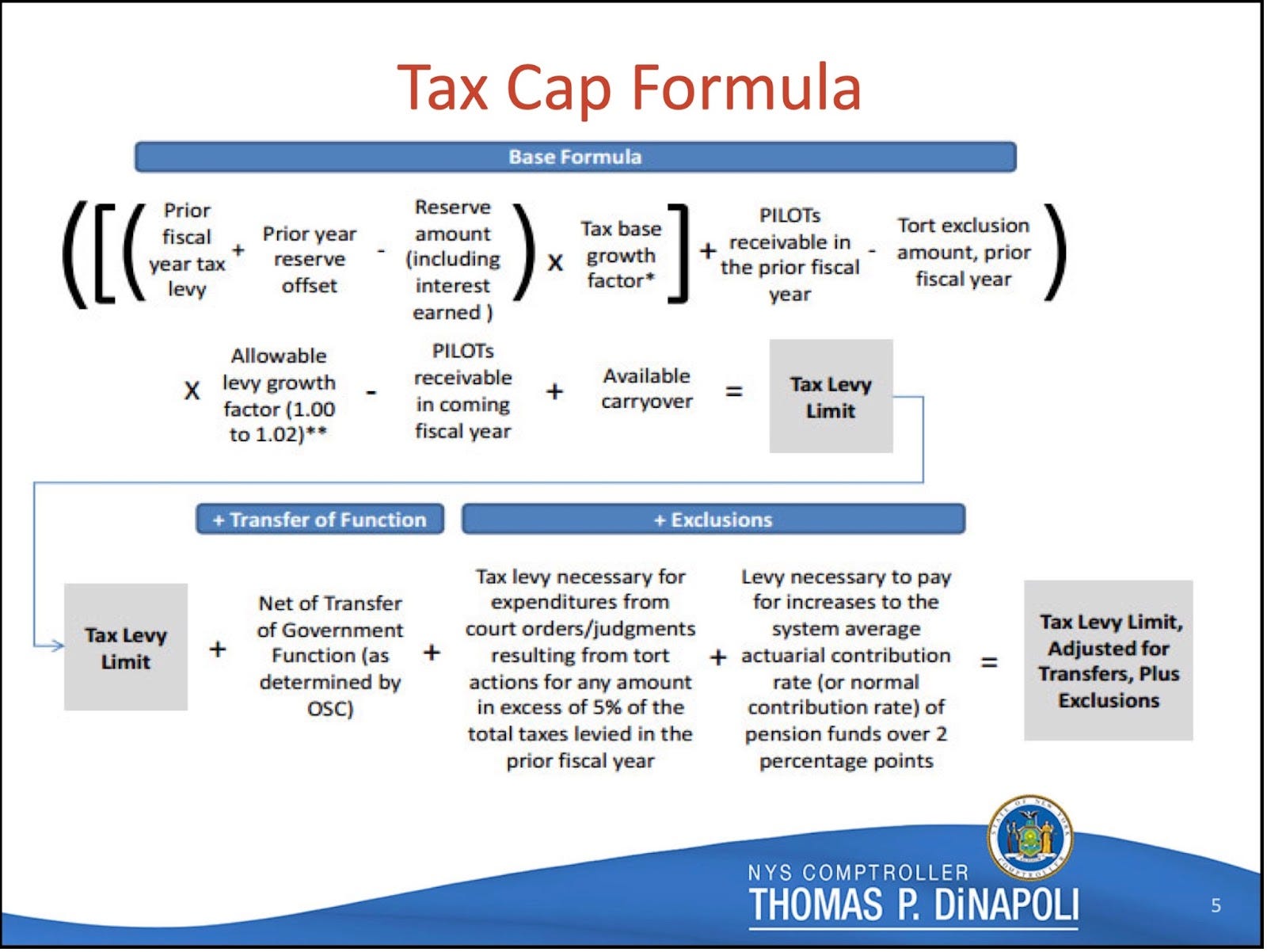
As you can see from the formula the levy cap is not as daunting as it might otherwise seem– a critical feature of the tax is the idea of keeping taxes in line with the prevailing level of inflation as measured by the CPI-U index that the Bureau of Labor and Statistics supplies on a monthly basis.
Lets do some simple math: ([($2,952,238.00 + 0 -0)x 1.0272] + $9,436 - 0) X 1.02
- $9,436 + $2,174 = “Tax Levy Limit “ or $3,091,204.37 before exclusions and a few other little changes.
This is a rough calculation, but it is close enough given the data we have to illustrate the ease of which one can make this calculation. It also illustrates that average members of the community can do many of these calculations and understand the process when given the information in a timely manner before public hearings to ask valuable questions of his or her representative on the town board.
We don’t have the exact amount of the PILOT(Payments in Lieu of taxes/tax incentives for businesses) ) for this current budget that the town plans on receiving in the year 2025 or the actual amount they received in 2024 — we used an estimated amount based on the data we have available from the Greene County Industrial Authority and the Office of State Comptroller. This PILOT amount could have been adjusted down as it was in 2023 to 2024.
However, the fact that this rough calculation is within 1.17% of the town’s stated amount is well within an acceptable error of margin for our purposes of demonstrating the Tax Cap Formula’ s function.
The more important question is how did we get to this level of spending? The reasons stem from normal expenses like: debt service, increases in salaries, decreases in the mortgage tax, reduction in fees from permits or fines, increases in insurance and other general operating costs like fuel and equipment repair. Windham started the fiscal year of 2024 with a $9.2+ million debt. This is our best estimate from data disclosed on the State Comptroller website. Unfortunately the 2024 adopted Budget for Windham lacks a disclosure of long term debt obligations. These long term obligations increased the overall debt service to $547,723.08 for this year alone by our calculations. The general trend that we can see in our budgets from 2019 to 2024 is a growth of debt service directly related to long-term capital projects like the Ambulance/Senior Center and the New Highway Department Building.
While debt services are rising our share of the Mortgage Tax that rose between 2020-2022 fell sharply in 2023. The 2024 fiscal data isn’t complete. But, the town board in 2024 estimated the mortgage tax at merely $80,000.00[below the pre-Pandemic level]—this would mean a drop of more than $190,000 from 2023 level of $274,514 and more than $265,000 then the peak of $345,596 received in 2021.
These facts coupled with increases in the cost of insurance premiums, energy and utility costs, material costs, and more due to the general level of inflation over the past several years has caused a general increase in the cost pressures for local governments of all sizes. This is especially true when you couple these inflationary pressures with the reduction of Federal aid to pre-pandemic levels which reduced availabe funds to offset expenses in the budget . As always prices after the inflationary pressure have shown a tendency to maintain their new price level even as the reduction of inflation has continued. Although we now are in a lower inflationary period our everyday prices are stabilizing at higher general rates for most commodities and services. This increase in general pricing will affect the budgets of governments of all sizes as well as the average consumer too long into the foreseeable future.
Inflationary pressures are certainly part of the overall increase in our tax burden now being felt. However, we should also not forget that large scale projects in our community with long-term debt obligations are also responsible to for increasing the tax burden too. We feel that long-term debt obligations have to be properly offset within the budget with other revenue generating schemes– one such scheme is to increase general prosperity of the community. So as the property values increase the average income also increases at a greater rate thereby offsetting the gains of increased property tax with more disposable income. A policy of generating revenue positive projects in the community through long term career building is the greatest way to ensure a tax base that isn’t growing faster than average local incomes are.
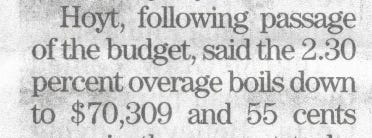
While Hoyt is correct that the 2.3% might only be $70,309.55 above the total tax levy cap– that’s not what we the citizens of Windham are paying in extra taxes– we are in fact paying on $175, 074.55 or 5.9% over last year’s $2,952,328.00 tax levy for the fiscal year 2024. So, this $70,309.55 is really only part of the much larger tax increase of $175,074.55. The question then becomes, exactly how much this increase in level will cost the average home owner? Again, let’s do some simple math— according to the Tentative Budget of Greene County Windham has an assessed value for all its properties at $858, 157, 627.00. So the formula for this looks like the following:
Tax rate per thousand = (tax levy ÷ total of all taxable assessments in jurisdiction) x 1,000
( $3,127,402.55 / $858,157,627.00)x 1000 = $3.64 per thousand at this point. To make this example more concrete let’s imagine you have a home with a $120,000 tax assessment value that means your bill will be $120x $3.64 = $600.60. Now if your assessment value is $500,000 then you’re going to be paying $500 x $3.64 = $1820.00. This turns out to be a $.20 cents increase per $1000 dollars estimated. This is only an estimate because assessments can change during a fiscal year. However, it will be very close to our actual numbers baring any extreme changes in Windham’s property values. The only way our property tax will radically change is if the following conditions exist: 1) If we were to see a sharp decline in property value or assessment value relative to our tax burden then this would sharply raise taxes per $1000 in response. 2) If the converse of that were to occur with sharply rising property values or assessment value relative to the tax burden then the property taxes would decrease per $1000.
And this leads us into our next part of the article the question of the “Carryover”.
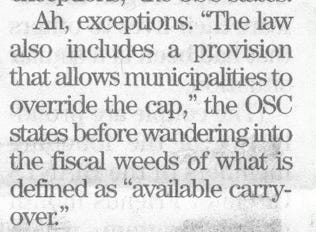
Mr. Ryan seems to want to address the “available carryover” function in the Tax Cap Law— it’s not clear to us why the rest of the article focuses on this element of the Tax Cap law. Simply put, the “carryover” is designed to take up the slack during fiscal budget years where the tax levy exceeds the demands of the taxes required to support the town’s spending. This excess amount of tax levy is then added to the next fiscal year to offset the tax cap growth. It allows the tax levy to expand by 1.5% or the difference between the two consecutive fiscal budget years. It’s usually a very small part of the entire calculation.
Since, the current budget only seems to have the relatively small amount of $2,174.00 that can be carried over from 2024 to 2025. It certainly didn’t offset much of the Growth in our budget— but certainly any little bit helps.
It’s certainly not clear from the article if Mr. Ryan is talking about our current budget period right now or just carryover in general,but, there is carryover from 2024 to the 2025 Budge. This as we said is $2,174.00 according to the information filed with the Office of State Comptroller for New York.